

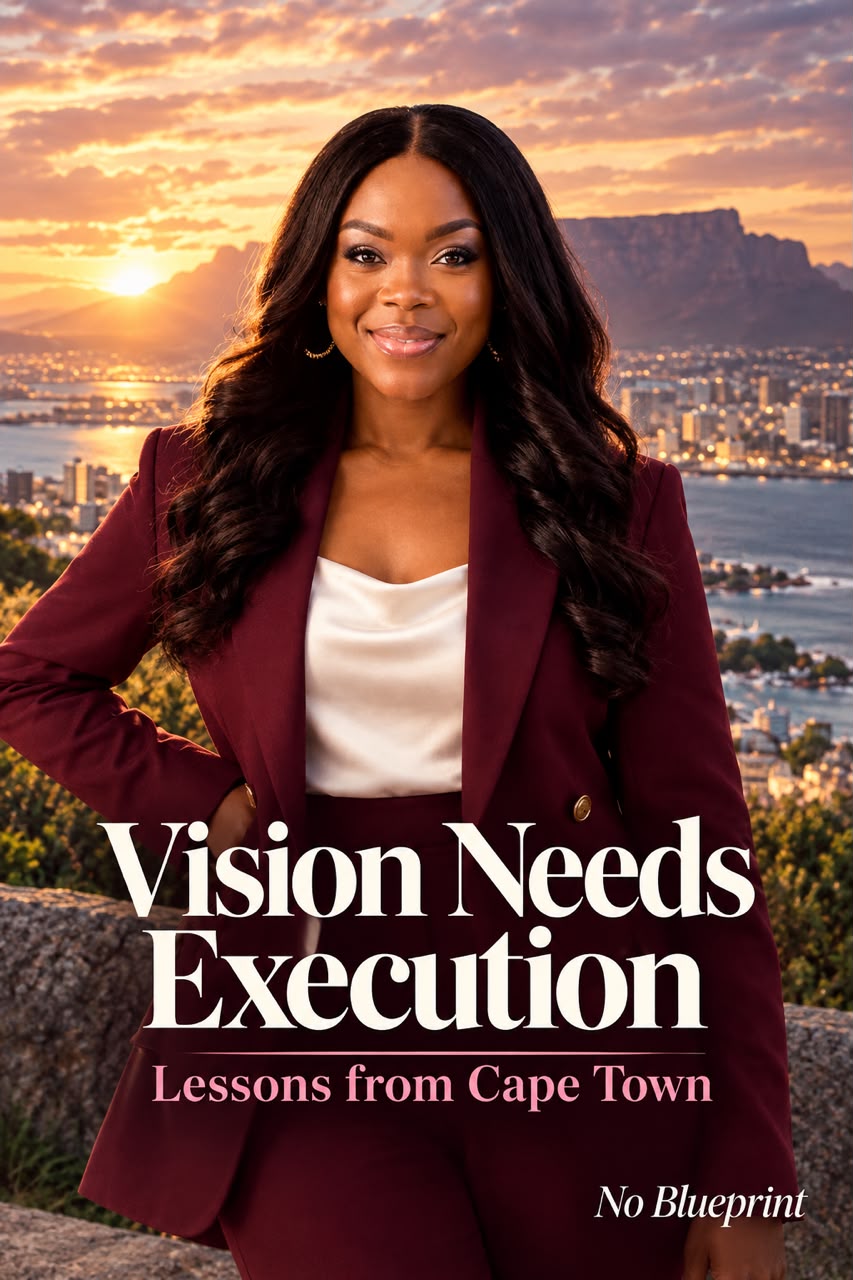
Bottom line: vision without execution is just wishful thinking — a truth I carried from twenty years in enterprise IT into my career pivoting toward film producing, reinforced again at the PMI Global Summit in Cape Town. I landed back from Cape Town last night, jet-lagged and still buzzing. I’d planned to write this week about what it takes to keep building when someone hands you a hard no. That conversation will have to wait until next week, because I just spent the last few days at the PMI Global Summit Series Africa, and there’s too much I need to unpack first.
For more than twenty years, before I became a filmmaker and founder, my world was enterprise IT. I lived in Gantt charts, risk registers, stakeholder decks, and resource allocation spreadsheets as a project manager and program director. When I stepped into film and founder life, a lot of people assumed I was hitting reset — that moving from tech infrastructure to storytelling was a full pivot away from everything I’d built.
It wasn’t. It was a translation.
Filmmaking isn’t just an art form. It’s extreme, high-stakes project delivery. You build a multimillion-dollar temporary company from scratch, hire a massive team of specialists, execute under brutal daily deadlines, and dismantle the entire operation within months. Standing in Cape Town surrounded by global project leaders, one idea kept coming back to me: creative vision without execution is just wishful thinking.
The Call Sheet Is Just a Sprint
The summit opened with a session led by George Asamani, PMI’s Managing Director for Sub-Saharan Africa, on the theme “Africa Delivers MORE, Together.” Using the African Continental Free Trade Area as a lens, the conversation centered on one hard question: how do you turn ambitious continental priorities into measurable outcomes?
That question isn’t unique to continental policy. It’s the exact question every director and every founder faces at a smaller scale. A filmmaker can have an extraordinary creative vision, but if the production lacks delivery discipline — managing scope creep, tracking the critical path, aligning a dozen competing stakeholders — the project collapses before it ever reaches post-production. A call sheet is essentially a sprint plan backlogged to the minute. When directors understand realistic scope and pacing, creativity actually thrives, because the crew isn’t running on 16 hours of disorganization.
Scaling Across 25 Countries
One of my biggest motivations for making this trip was personal. My mother, Abimbola Daramola, presented alongside Dr. Fola Ojuola on how their organization scaled hybrid and digital learning initiatives across 25 African countries — different regulatory environments, different infrastructure, different languages, all under one governance framework.
Sitting in that room, listening to her break down stakeholder alignment and impact measurement at that scale, I kept coming back to one line I’d write down for any founder: passion starts the mission, but governance finishes it. Whether you’re scaling digital education across a continent or producing a film with international crew and financing, your capacity to actually deliver comes down to the systems underneath the vision. The more unpredictable the terrain, the more reliable your process has to be.
Change Management Is a Collective Discipline
The summit closed with a fireside conversation with Sabrina Walter, founder of Women For Change, on how her organization mobilized more than one million people to demand that gender-based violence and femicide be declared a national disaster in South Africa.
Listening to her walk through the strategy behind that movement — the messaging discipline, the sustained pressure, the coordination across a huge and disparate group of people — was a masterclass in change management at the highest possible stakes. Moving a system, whether it’s a government or a company culture, is never accidental. It’s deliberate, structured, and executed with the same rigor as any other complex project. Whether the work is cinema or advocacy, the actual measure of it is whether it produces real, tangible change.
Making Time to Look Up
In the middle of all that seriousness, I made sure to carve out time to actually see the city. Of course I had to make my way up Table Mountain for the first time — I was fully unprepared for how much wind and cold hits you at the top, even in what should have been mild weather. I also stood at the Cape of Good Hope, the most southwestern point of the African continent, which is one of those moments that puts everything in perspective. And no trip to Cape Town is complete without Boulders Beach, watching African penguins wander around like they own the place, or an evening at the V&A Waterfront.
I don’t take for granted that I get to explore the world this freely while still working and building. That combination is a gift, not a given. And on that note, I’m genuinely excited about a film collaboration in the works with an incredible studio based in Cape Town — more on that soon.
The Blueprint You Already Carry
Walking out of that summit, I reflected on my own transition from corporate IT into film and entrepreneurship. When we pivot into a new chapter, there’s often an urge to discard the old one — to prove the new direction is a clean break from what came before.
Cape Town proved the opposite to me. Every hour I spent managing rollouts, mitigating risk, and resolving stakeholder conflict over two decades is directly powering my capacity as a founder and film producer today. The tools didn’t change. Only the canvas did. And that’s true no matter what field you’re building in — the discipline that made you good at one thing rarely disappears when you move into the next. It just needs a new language.
When there’s no blueprint, your execution discipline is the only compass that actually holds.
What’s a skill from an earlier career or a previous chapter of your life that you’re quietly relying on to build what you’re working on now? I’d love to hear it in the comments.